
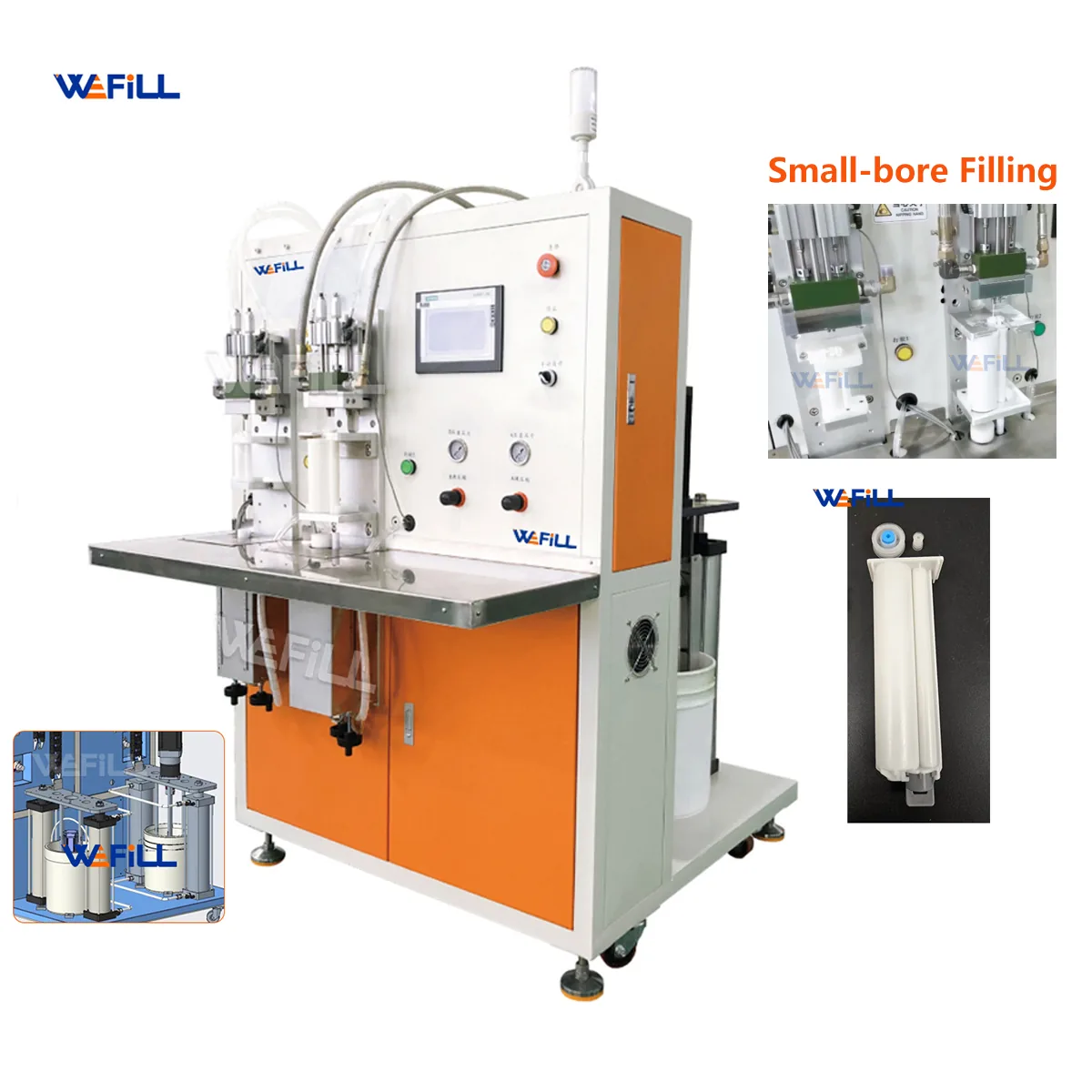
Front outlet filling changes the nozzle, fixture and air-management strategy, plus how you handle high-viscosity AB materials. Not a cosmetic variant.
Two ways to get adhesive into a cartridge
On a conventional back-fill line, the empty cartridge is filled from the open rear first. After filling, the piston is pressed in by a plunger station to seal the cartridge. On a front-fill machine the material is dispensed through the cartridge outlet at the front, with the piston travelling in the opposite direction as the cavity fills.
Both produce a filled cartridge. They differ in how air leaves the cavity, how the nozzle seals, and how much of the filling path has to be purged between batches.
Why front filling exists
For viscous two-component materials, filling through the outlet can reduce trapped air around the divider and give a cleaner start to the bead. It also suits cartridges that cannot be conveniently opened at the rear, and short batches where a compact semi-automatic cell with a front-outlet head is easier to clean than a full rotary line.
Our front-outlet platform is built around this approach: a semi-automatic 10:1 cell intended for 490 ml class AB cartridges, where changeover and clean-down matter more than maximum cycle rate.
What it means for fixtures and cycle time
A front-fill head needs a reliable seal at the cartridge nozzle and a controlled retraction to avoid stringing. The fixture has to hold the cartridge square against that force, which makes the tooling more format-specific than a simple back-fill cradle.
In exchange, the station count can be lower. For a laboratory, a contract filler or a plant running several formulations a day, fewer stations often means less cleaning and faster qualification than a higher headline speed.
When back filling is still the better choice
If your format is standard, the batch is long and the material flows readily, a conventional automatic line will normally win on output and on integration with plunger insertion, capping and labelling. Front filling earns its place when air entrapment, format constraints or cleaning effort dominate the decision.
The honest answer depends on your material. A sample filling trial on both approaches is the fastest way to see which one gives a stable bead and acceptable clean-down time.
Discussing a filling project?
Send your material and cartridge details. Our engineers will recommend a configuration and confirm feasibility after a sample filling trial.